
Contactless Smart Cards: What ISO 14443 Means for Access Control
ISO/IEC 14443 defines the radio interface and communication protocols used by many proximity credentials. It can help contactless smart cards and readers communicate, but it does not by itself establish that a card is genuine, that its data is protected, or that a person is authorized to enter. Those outcomes depend on the credential application, cryptographic configuration, reader, controller, and access-management system.
This distinction matters when an organization replaces readers or combines credentials across sites. A new reader may detect a card yet fail to authenticate it, or it may read only the card’s identifier while the intended deployment requires a protected application. Treat “ISO/IEC 14443 compatible” as a starting point for evaluation, not an acceptance criterion for the complete access-control system.
Where the standard fits in an access transaction
ISO/IEC 14443 is commonly described in four parts. The applicable edition and amendments should be confirmed against the procurement specification; a broad reference to the standard does not identify every option a device implements.
Type A and Type B are alternative communication schemes within the standard, not security grades. A reader advertised as supporting both may still lack the particular card application, command set, keys, or configuration needed for a deployment. Conversely, support for one type can be sufficient when the organization has a controlled credential population and has verified the whole transaction.
Part 4 support also deserves explicit checking. A device can communicate at the lower layers without supporting the application-level exchange required by a particular credential. Ask suppliers to identify the parts and options implemented by both the card and reader, rather than relying on the frequency or the phrase “smart card compatible.”
Interoperability has several layers
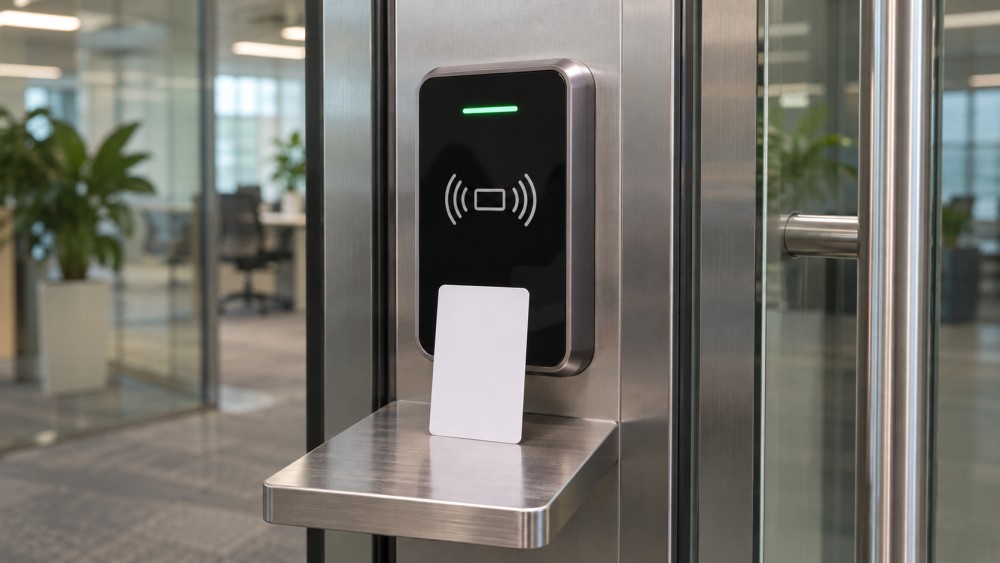
At a door, the reader must first energize and select the card. It then needs to recognize the relevant credential application and perform the required exchange. Finally, the reader or another trusted component sends a usable identity or authorization request to the controller. A failure at any layer can look the same to the cardholder: the door does not open.
Consider a reader replacement where the old cards are detected but not accepted. The cause might be unsupported Type A or Type B operation, an application the new reader cannot process, missing keys, a different credential-number format, or a controller that cannot interpret the output. A simple card-present indication proves only that some radio communication occurred; it does not prove that the intended authentication or authorization path worked.
Card identifier versus authenticated credential
Some systems make an access decision using a card identifier read during initial communication. That approach should not be described as cryptographic card authentication. Identifiers may be observable, may not be globally unique in every implementation, and can be unsuitable as proof that a credential is genuine. Some cards also use changing identifiers, which can make identifier-only workflows unreliable.
A stronger design uses a credential application capable of cryptographic authentication and configures the reader or trusted system component to verify it. The evaluator should establish which party authenticates which, which keys are used, and whether the access decision is based on authenticated application data rather than an easily observed identifier. ISO/IEC 14443 does not prescribe those choices for every access-control deployment.
Security questions that the radio standard cannot answer
Two cards can both use the ISO/IEC 14443 interface and provide different security properties. The meaningful unit of comparison is the configured system: credential type and application, key management, reader firmware, controller connection, and operational processes.
- Authentication: Does the reader verify possession of a secret or private key? Is mutual authentication supported and enabled where required? Obtain a description of the actual transaction, not just a list of algorithms.
- Key ownership: Who generates, provisions, stores, rotates, and revokes keys? Establish whether keys are shared broadly or diversified per credential, and whether the customer can migrate to another supplier without exposing secrets.
- Data protection: Identify what card data is read, whether the relevant exchange provides integrity or confidentiality, and where protected data becomes available in plaintext.
- Reader-to-controller path: Determine whether messages are authenticated and protected in transit, how devices are commissioned, and what happens when a reader or its wiring is tampered with. Card-to-reader protection does not automatically extend across this connection.
- Administrative controls: Check who can enroll credentials, change reader settings, issue replacement cards, and alter access rights. A sound card protocol cannot correct an uncontrolled issuance process.
Also distinguish cloning resistance from relay resistance. Cryptographic authentication can make copying a credential’s secret substantially harder when implemented correctly, but it does not necessarily prevent an attacker from relaying a live exchange between a legitimate card and a reader. Where that threat matters, ask for evidence of the specific mitigation, its operating assumptions, and its compatibility with the proposed hardware.
Plan a migration around the credential population
A mixed estate is often the difficult case: existing cards may need to work at old doors while upgraded readers introduce a new credential application. Inventory the credential technologies, applications, reader models, firmware versions, controller interfaces, and access rules before choosing a transition mode. Include contractors and infrequently used sites; they can expose compatibility gaps after the main deployment appears complete.
Then define the acceptable combinations. For example, a reader might support both a legacy identifier-based mode and a cryptographically authenticated mode. That can preserve access during migration, but it also leaves the weaker path available wherever it remains enabled. Document which doors may use it, who can authorize exceptions, how those exceptions are monitored, and the condition for disabling it. A dual-mode reader should not silently fall back to a weaker method when authentication fails.
Check issuance and recovery alongside door operation. A replacement credential needs the right application and keys, an identity binding in the access system, and appropriate permissions. Lost-card revocation must reach the relevant controllers under the actual network conditions. Where controllers can operate offline, specify how revocation updates are distributed and what access remains possible until an update is received.
Turn supplier claims into a testable specification
Request a compatibility matrix that names the exact card application, reader model, firmware, controller interface, and configuration. A statement that equipment supports ISO/IEC 14443 is not equivalent to a statement that a particular credential can be securely used at a particular door. Record the standard edition or editions referenced and ask whether a claim is based on supplier testing, an independent assessment, or another form of evidence.
Certification requires the same precision. Ask for the certificate or assessment report, issuing body, product and version covered, scope, and validity status. A certificate covering a card component, a radio interface, or a laboratory configuration should not be presented as certification of the complete installed access-control system. Verify the scope against the proposed configuration before using it as acceptance evidence.
A practical pilot can then test the complete path under documented conditions:
- Establish the baseline. Identify test cards, reader settings, controller firmware, key-provisioning method, and the authorization rules expected at each test door. Record whether legacy modes are enabled.
- Exercise normal access. Present enrolled and unauthorized credentials, verify the door response, and compare the controller’s event record with the actual decision. Include every credential and reader combination intended for production.
- Test negative conditions. Use an expired or revoked credential, an incorrectly provisioned application, and a reader missing the required key or configuration. Confirm that failure does not trigger an unintended identifier-only fallback.
- Check operating conditions. Try representative installations, including mounting surfaces, enclosures, and presentation positions. Test expected behavior during controller or network interruption without assuming that all doors share the same fail-safe or fail-secure requirements.
- Verify lifecycle actions. Issue, replace, suspend, and revoke a test credential through the normal administrative workflow. Confirm where the change is recorded and when each relevant controller enforces it.
Define acceptance before testing: which combinations must work, which must be rejected, which events must be logged, and what evidence demonstrates that the protected credential application—not merely the card identifier—was used. Record failures and configuration changes so a successful retest can be tied to a reproducible setup.
Interpreting read range and availability claims
ISO/IEC 14443 describes proximity operation at 13.56 MHz, but a standard reference does not guarantee a particular read distance at an installed door. Antenna design, card orientation, reader power, nearby metal, mounting material, and interference can all affect the result. A range demonstrated on a bench is useful only when its setup is stated and compared with the intended installation.
Availability requirements can also change the security decision. A data-center door, for example, may need different behavior during a controller failure from an ordinary office entrance. Specify the required door response, local authorization behavior, event retention, and restoration procedure with the relevant facilities and safety requirements in view. A card protocol alone cannot determine whether the installed system will meet those conditions.
The final procurement record should tie each security requirement to an observable result: the exact credential and reader configuration, the evidence supplied, the pilot outcome, and any temporary exception. That record makes it possible to distinguish demonstrated interoperability from a general standards claim—and to identify which controls must be preserved when firmware, readers, or credential applications change.
Want to dive deeper into these market dynamics, or need data-driven support for your next business move? Drop a line below and let the analysts at CyberTrade provide customized insights.
Related News
 Identity AccessIs Cloud-Hosted RADIUS a Good Fit for Multicloud Enterprises?Posted on Nov 18, 2026Is a cloud-hosted RADIUS server a good fit for a multicloud enterprise? Explore integration, security, resilience, and costs before you decide.
 Identity AccessHow to Test RADIUS Failover Across Cloud RegionsPosted on Nov 18, 2026How do we test RADIUS failover across cloud regions? Follow a practical guide to verify recovery, secure access, audit logs, and failback.
 Identity AccessHow to Choose a Certificate Authority for Multicloud WorkloadsPosted on Nov 18, 2026How do we choose a certificate authority for workloads across multiple clouds? Explore key criteria, compare CA options, and plan a production-ready pilot.
 Multi-CloudHow to Verify CASB Visibility Across Multiple CloudsPosted on Nov 18, 2026How can we verify a CASB's visibility across multiple clouds? Learn to test coverage, trace events, uncover blind spots, and build a reliable assessment.
 Cloud SecurityHow to Test WAF Attack Blocking Without Disrupting Legitimate TrafficPosted on Nov 18, 2026How do we test whether a WAF blocks attacks without disrupting legitimate traffic? Explore safe simulations, false-positive checks, and staged enforcement.
 Identity AccessCan Smart Cards Work With Cloud Apps Without Replacing Your IdP?Posted on Nov 18, 2026Can smart cards work with cloud applications without replacing our identity system? Discover the integration requirements, security benefits, and pilot checks.
 Prices & CostsHow to Compare Cloud HSM Total Costs Across ProvidersPosted on Nov 18, 2026How do we compare the total cost of cloud HSMs across providers? Discover the hidden charges, key assumptions, and practical steps for a fair comparison.
 Multi-CloudHow to Verify Consistent API Gateway Authentication Across CloudsPosted on Nov 18, 2026Verify API gateway authentication across clouds with practical tests for tokens, routes, bypass risks, and policy enforcement. Explore the guide.
 Cloud SecurityDo You Need a Next-Generation Firewall in Every Cloud?Posted on Nov 18, 2026Do we need a next-generation firewall in every cloud environment? Explore traffic risks, cloud-native controls, costs and deployment options.
 Threat ResponseHow to Tell If a Cloud IDS Is Missing TrafficPosted on Nov 18, 2026How can we tell whether an IDS is missing traffic in a cloud environment? Compare flow evidence, test sensor visibility, and uncover hidden coverage gaps.
 Identity AccessHow to check if a certificate authority is trustedPosted on Nov 18, 2026Certificate Authorities aren't trusted equally everywhere. Learn how to check certificate chains, trust stores, and revocation before choosing a CA.
 Cloud SecurityCan cloud access security brokers detect shadow IT?Posted on Nov 18, 2026Cloud Access Security Brokers can uncover shadow IT—but visibility has limits. Discover how CASBs detect cloud apps, expose blind spots, and guide a practical response.











